


Created during his residency at Eclectica Contemporary, this portrait by Loyiso Mkize does something rare: it returns Winnie Madikizela-Mandela to herself.
Too often, Winnie is spoken about through the names of men, through scandal, through political convenience, or through the anxieties she provoked. She is too seldom considered as one of the most formidable political figures South Africa has produced in her own right. Not an appendage to history. Not a supporting character in the story of Nelson Mandela. A force.
Before the world knew her as Mandela’s wife, she was already shaped by discipline, pride and political awareness. She came from a respected family, was highly intelligent, and entered Johannesburg with an understanding of racial injustice that did not begin with marriage. Yet, like many women in political spaces, she was initially expected to stand beside power rather than embody it.
History had other plans.
When Nelson Mandela was imprisoned on Robben Island, Winnie became the visible nerve of resistance inside South Africa. While many leaders were jailed, exiled or underground, she remained in the line of fire. She kept international attention on political prisoners, challenged the state publicly, and became a symbol of defiance in townships where fear was meant to rule.
The apartheid government understood her influence. That is why they harassed, detained, isolated and banished her to Brandfort. That is why they held her for 491 days in detention. That is why they tried to break her. States do not persecute the irrelevant. They persecute those who matter.
And yet much of democratic South Africa has remained more comfortable with a softened version of liberation than with the reality of a woman like Winnie. She was too blunt, too angry, too uncompromising, too unwilling to perform gratitude. Men with similar temperaments are often called strong. Women are called dangerous.
None of this erases the painful controversies attached to her name, including the tragedy surrounding Stompie Seipei. History must be honest. But honesty must be consistent. South Africa has often granted male figures complexity while denying it to Winnie. She was expected to be either saint or villain, never human.
What I have always seen in her is something many women recognise immediately: the punishment reserved for women who refuse submission. Winnie carried beauty, intellect, political instinct and courage, and for that she was admired, feared, smeared and used in equal measure.
This painting matters because it captures stature. It captures presence. It captures a woman who could not be diminished, no matter how often people tried.
The work was completed before lockdown during Loyiso Mkize’s residency at Eclectica Contemporary, and we had the privilege of supporting the artist through its creation over many months. To now see it re-emerge as the cover image for Netflix’s The Trials of Winnie Mandela feels timely and deserved.
Winnie Madikizela-Mandela remains one of the most misunderstood figures in South African history. She was difficult because the times were difficult. She was fierce because softness would not have survived. And whether one agrees with every chapter of her life or not, this country owes her far more than it has been willing to admit.
– ST
View the trailer of the Netflix documentary ‘The Trials of Winnie Mandela”, as shared from Loyiso Mkize’s Instagram profile, below.
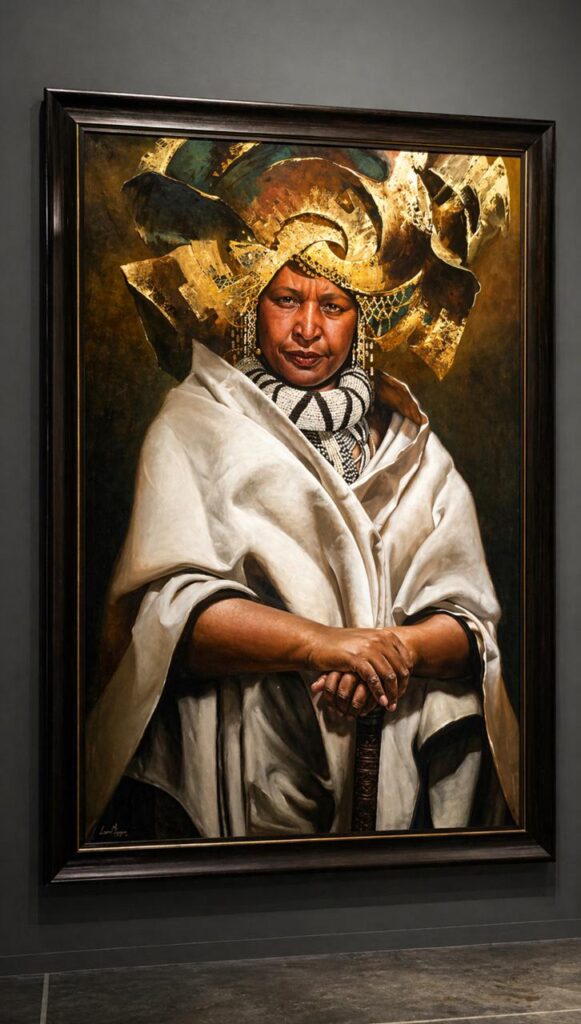
Loyiso Mkize, NOMZAMO, 2019

Loyiso Mkize, The Trials of Winnie Mandela, as featured on Netflix