


The paintings of Johannes Phokela don’t ask to be admired. They unsettle first.
At a distance, they appear controlled, even obedient. The language is familiar, the weight of European Old Master painting, its authority, its discipline, its promise of clarity. But that promise doesn’t hold for long. The closer you look, the more the image begins to slip. What appears virtuous at first glance starts to fracture, and what seemed stable reveals itself as performance. Phokela doesn’t quote tradition. He uses it against itself.
Presented within the context of the Venice Biennale, in a curated vision initiated by the late Koyo Kouoh, this body of work sharpens its focus on virtue not as truth, but as something constructed, rehearsed, repeated, and maintained. The Seven Virtues : Chastity, Temperance, Charity, Diligence, Patience, Kindness, Humility, are not upheld here. They are staged. Tested. Quietly undone. There is a simple premise running through the work: “do as I say, not as I do.” But in Phokela’s hands, this is not hypocrisy as exception. It is hypocrisy as structure. His figures occupy both sides at once, performing virtue while simultaneously dismantling it. The tension is constant. Between image and intention. Between what is shown and what is implied.
Nothing settles.
That instability carries into Original Sin (Inner Circle). Here, the visual language shifts toward a kind of controlled excess, bodies compressed into space, movement without release, a sense that something is about to collapse but never quite does. The references to Baroque painting are clear, but the meaning has moved. This is no longer about divine judgment. It is about systems. Power, in these works, is not distant or abstract. It is structured. It is coded. It operates through access, who is inside, who is outside, who decides. Masks, gestures, and symbols of entry and restriction repeat throughout the compositions.
They are not decorative. They are functional. They point to a world that is recognizable, shaped by hierarchy, by performance, by the quiet enforcement of belonging and exclusion. Even the idea of “sin” shifts here. It is no longer theological. It becomes institutional, embedded in the systems that claim moral authority in the first place.
What makes these paintings hold is that they refuse to resolve. Temperance appears in spaces of excess, where restraint feels staged rather than lived. Patience reads less like virtue than endurance. Humility sits uncomfortably close to power, beginning to resemble strategy rather than sincerity. Everything is slightly off. Eclectica Contemporary’s work with Phokela has not been about introducing a new voice. It has been about recognizing one that was already formed, and placing it with clarity. Johannes has a long exhibition history, working across galleries and contexts over many years. The recognition he is receiving now is not sudden. It has been built slowly, often without visibility, and often without ease.
The shift came when the work was given the right conditions to be seen properly.
His solo presentation with Eclectica Contemporary at Investec Cape Town Art Fair was an important moment. The booth was a complete success. Not driven by hype, but by conviction. Collectors didn’t respond to spectacle, they responded to depth. The work held them. That matters, especially within the context of a fair, where attention is fragmented and decisions are often made quickly. Phokela’s paintings resist that speed. They slow the viewer down. They ask for time, and in doing so, they separate themselves from everything around them.
– ST Eclectica Contemporary
Read the full publication on Art Africa Magazine.

Johannes Phokela, Justitia,Oil on canvas

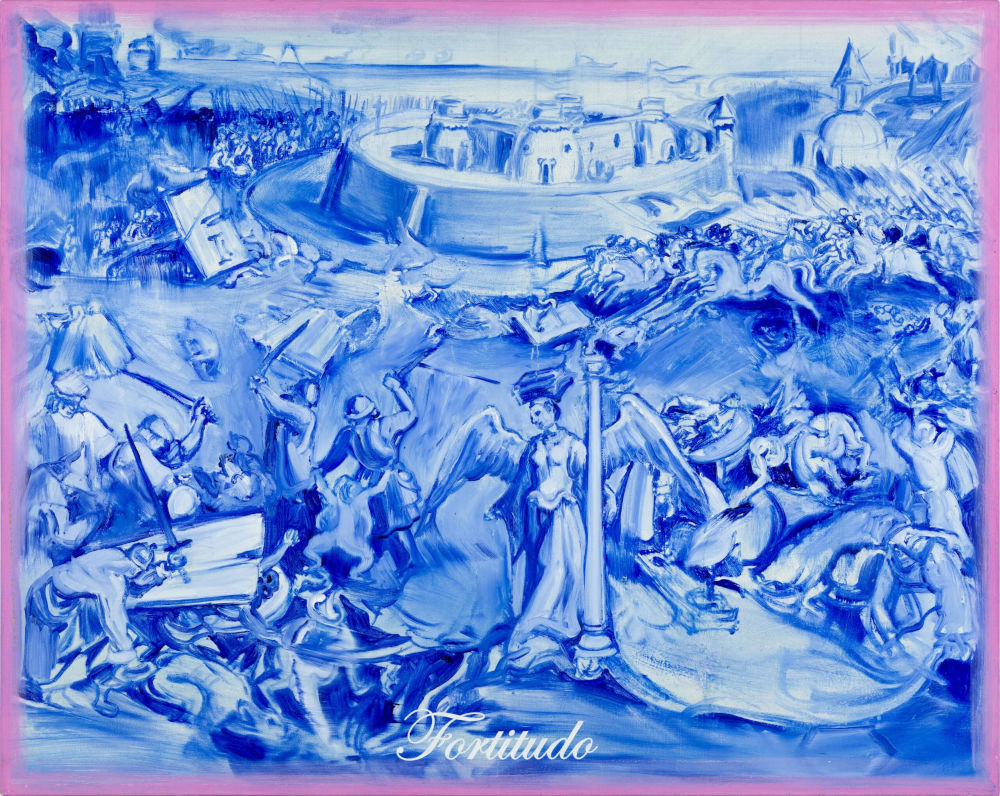
Johannes Phokela, Fortitudo, Oil on canvas